Why Are RAM Prices So High Right Now? Understanding the 2025 Memory Shortage#
If you're shopping for RAM in late 2025, you've likely experienced serious sticker shock. DDR5 memory prices have roughly doubled since mid-2025, with some popular kits increasing even more dramatically. A standard 32GB DDR5 kit that cost under $95 just six months ago now sells for approximately $184, and certain configurations have seen prices quadruple.
This isn't a temporary spike. The RAM price increase represents a fundamental shift in the memory market driven by AI demand, supply constraints, and manufacturer priorities. Here's everything you need to know about why RAM is so expensive right now and what you can do about it.
Current RAM Price Trends: The Data#
The graph below shows average pricing for DDR5-6000 2x16GB kits over the past 18 months. The steep upward trajectory starting in mid-2025 tells the story clearly.
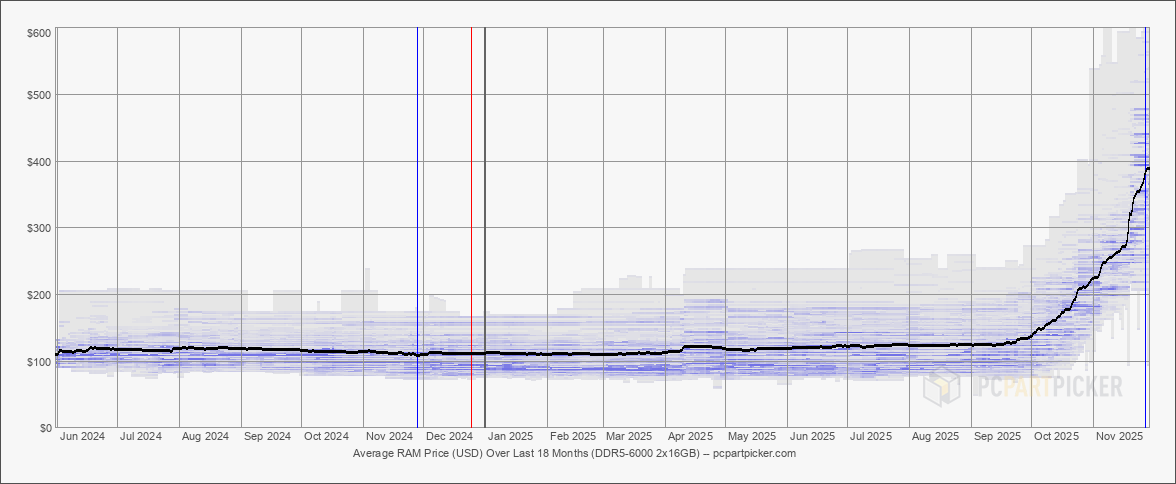 DDR5-6000 2x16GB price trend over 18 months
Recent Market Data
Recent market data shows:
- DRAM contract prices jumped 171.8 percent year-over-year in Q3 2025
- Consumer DDR5 memory costs have approximately doubled since mid-2025
- DDR4 memory prices have also increased significantly though not as dramatically
- Industry analysts report some retailers implementing purchase limits to prevent scalping
What's Causing High RAM Prices in 2025?#
AI Data Center Demand for Memory#
The primary driver behind expensive RAM is artificial intelligence infrastructure. AI data centers require massive amounts of high-bandwidth memory (HBM) for training and running large language models and other AI systems. Major memory manufacturers have presold their HBM production capacity through 2026 to meet enterprise AI demand.
This AI memory boom has created a ripple effect throughout the entire memory market. When manufacturers dedicate production lines to high-margin enterprise products, consumer RAM production gets squeezed.
Limited Memory Manufacturer Competition#
Only three companies control the majority of global memory production: Samsung, SK Hynix, and Micron. This oligopoly limits competition and gives manufacturers significant pricing power. After cutting production during the 2022 memory market downturn, these companies have been slow to ramp production back up.
Semiconductor Fab Constraints#
Building new semiconductor manufacturing facilities takes years and costs billions of dollars. Even if memory manufacturers wanted to flood the market with cheap RAM immediately, the physical production capacity doesn't exist. New fabs coming online won't provide meaningful relief until 2026 at the earliest.
Prioritization of High-Margin Products#
Memory manufacturers earn significantly higher profit margins on enterprise and AI-focused memory products compared to consumer DDR4 and DDR5 modules. This economic reality means consumer RAM production takes lower priority in manufacturing schedules.
What We're Seeing at Techbay#
The RAM price crisis is changing customer behavior in noticeable ways:
Delayed builds and upgrades: Many customers are postponing PC builds entirely because memory costs have blown past their total component budgets.
Reduced capacity purchases: Buyers who planned to install 32GB or 64GB of RAM are starting with 16GB or 32GB instead, hoping to upgrade later when prices improve.
Used memory market growth: First-time buyers are turning to used RAM markets because new pricing has become prohibitive for budget builds.
Inventory challenges: We've increased our own memory inventory because ordering RAM between customer quote and build completion now risks significant price jumps.
Some major retailers have responded by implementing daily spot pricing instead of fixed prices, rationing sales, or removing price tags entirely from memory products.
When Will RAM Prices Go Down?#
Unfortunately, memory prices are expected to continue rising in the near term. Industry forecasts predict manufacturers will increase prices by 30 to 50 percent per quarter through the first half of 2026.
Some analysts suggest this memory shortage could persist for several years. However, others predict a potential semiconductor market correction in 2027 could bring price relief by late 2026 or early 2027.
The key factors that would drive prices down include:
- Stabilization of AI data center demand
- New memory fabrication capacity coming online
- Economic downturn reducing overall semiconductor demand
- Increased competition from smaller manufacturers
Until one or more of these factors materialize, expect RAM prices to remain elevated or continue climbing.
Smart RAM Buying Strategies for 2025-2026#
Buy Memory Sooner If You're Committed to Building
If you have a definite PC build timeline, purchase RAM now rather than waiting. Prices are trending upward, not downward. A kit at today's inflated price will likely cost even more in three to six months.
Consider Starting with Less Capacity
Modern motherboards support memory expansion. Starting with 16GB instead of 32GB, or 32GB instead of 64GB, lets you complete your build now and add more RAM later if prices improve. This strategy works well for gaming PCs where 16-32GB is typically sufficient.
Evaluate Used RAM Options Carefully
The used memory market offers potential savings but requires caution:
- Buy only from reputable sellers with return policies
- Verify memory speed and timing compatibility with your motherboard
- Test thoroughly immediately after purchase
- Understand that used RAM typically has no warranty
Don't Panic Buy Unnecessary Memory
If your current system runs smoothly with your existing RAM capacity, there's no urgent reason to upgrade just because future prices might be higher. Only buy additional memory when you're actually experiencing performance limitations.
Watch DDR4 vs DDR5 Pricing
For new builds, compare the total cost difference between DDR4 and DDR5 platforms. In some cases, choosing a DDR4-compatible CPU and motherboard can significantly reduce overall system cost even though DDR4 prices have also risen.
DDR5 vs DDR4: Which Should You Buy?#
With both DDR4 and DDR5 prices elevated, platform choice matters more than ever:
- You're building a high-end gaming or workstation PC
- You plan to keep the system for 5+ years
- You need maximum memory bandwidth for specific workloads
- You're buying the latest CPU generation that requires DDR5
Will the RAM Shortage Affect Other PC Components?#
The memory shortage is primarily isolated to DRAM and doesn't directly impact other PC components. However, high RAM prices do affect overall PC building costs and may influence purchasing decisions for other parts as buyers reallocate budget.
Final Thoughts on the RAM Price Crisis#
The memory market is experiencing a perfect storm of surging AI demand, limited production capacity, and manufacturer prioritization of high-margin enterprise products. For PC builders and upgraders, this translates to significantly higher costs and tougher budget decisions.
We'll continue monitoring RAM prices and market trends to provide our customers with up-to-date guidance. For now, the most practical approach is to plan carefully, buy strategically based on your actual needs, and don't expect the bargain memory prices of 2024 to return anytime soon.
Need help choosing the right RAM for your build or upgrade? Our team can help you navigate current pricing and find the best memory solution for your budget and performance requirements. Contact us for personalized recommendations based on today's market conditions.